kabarsula Bunnik Tours takes In-Style to Korea and Jeju Island bandar SLOT INDONESIA
Bunnik Tours has put its In-Style label on South Korea, and its first departure had the family name on the door in person. The inaugural Korea & Jeju In-Style ran from 24 October to 3 November: 11 days and 10 nights across Seoul, Jeju Island, Gyeongju and Busan. Dennis Bunnik joined the group himself, and Travel Weekly was on board as a guest of Bunnik Tours and Korea Tourism Organization.
The route
I fly Sydney–Incheon on Asiana Airlines (soon to fly in parent company Korean Air livery) overnight (OZ602, departing 21:45 and landing 6:30 the next morning), with early check-in confirmed at the first hotel I am picked up by DMC manager Jay, on the second of his morning pick-ups with more to come.
The tour moves through four five-star hotel bases:
- Seoul (three nights, Lotte Hotel Seoul)
- Jeju Island (three nights, Lotte Hotel Jeju)
- Gyeongju (one night, Hilton Gyeongju)
- Busan (three nights, Signiel Busan)

Seoul opens with a welcome dinner and a day of old and new: At Gyeongbokgung Palace we see the colourful Changing of the Guards, and explore the hills of Bukchon Hanok Village by pedicab, then it’s off to Insa-dong for lunch and to explore the artisan precinct before heading to the COEX Centre to pose – or dance – in front of the Gang Nam Style sculpture. Out tour also takes in the stunning and impressive collection held by the National Museum of Korea, the Insta-hit Starfield Library at COEX, and the 555-metre high Lotte World Tower Observatory to see tourists walk gingerly over glass paths hanging over the edge of the building. VIP seats at the Nanta Show means being sprayed with chopped up carrots and cabbage! You’ll never know if you don’t go.
Guests then take a short flight to Jeju Island for three nights of monolithic volcanic landscapes, including the ancient Jeju Stone Park, and the impressive pillars of Jusangjeolli Cliff, Seongsan Ilchulbong (Sunrise Peak) before heading down to snack on the fruits of the sea gathered by the famous Jeju women divers. Then is also a brief visit to Cheonjiyeon Waterfalls and the impressive digital Arte Museum. How’s the serenity so far?

Our flight to Busan leads us to Gyeongju, where the focus shifts to Silla-era heritage at Bulguksa Temple, Wolji Pond, ancient stone Cheomseongdae Observatory and the expansive Tumuli Park. The final stretch is in Busan for the moving UN Memorial Cemetery, a Gamcheon Culture Village visit, BIFF Square and Kukje Fish Market, and the scenic Haeundae Blueline Park Coastal Train for a quick dip in the West Sea before heading to Haedong Yonggungsa Temple and finishing with a Korean BBQ farewell dinner overlooking the neon-lit Gwangan (Diamond) Bridge in Busan.
The In-Style touches
The itinerary offers a string of upgraded experiences, not offered on the Discovery Tour, that advisors can use to justify the price point:
- A fun private pedicab tour of Bukchon Hanok Village

- A hands-on makgeolli (rice wine) class, where you get to drink the result
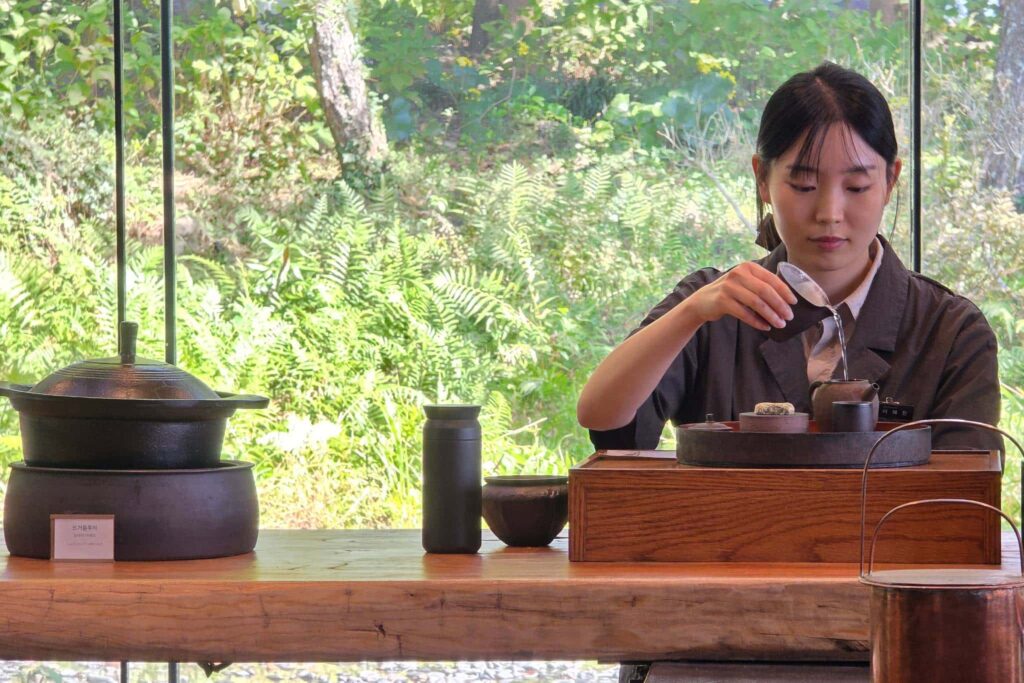
- A green tea-making class in the serene surrounds of the O’sulloc Tea Museum
- Fine-dining dinner at The Flying Hog on Jeju
- An amazing multi-course cultural dinner at Yoseokgung 1779, a restored hanok house in Gyeongju serving hanjeongsik cuisine
- a Golgulsa Temple experience with meditation (I managed to sit still for 10 minutes!), archery (missed) and a Seonmudo martial arts performance
Breakfast is included daily, with a mix of lunches and dinners built in. Several evenings are left deliberately free, including in Seoul after the Nanta Show and on the first night in Busan, and the itinerary pairs those gaps with suggestions, from Hongik University Street buskers to the Busan Air Cruise cable car.
What advisors should tell clients
The itinerary is candid about physical demands, which will help with client suitability. Several days involve walking on uneven ground: about 1.5 hours on the Jeju arrival day, three hours on the Jeju sunset day, two hours at Golgulsa on the way to Busan and 1.5 hours on the final full day. The longest transfer days run to around 2.5 hours of travel on Jeju and two hours between Gyeongju and Busan. Guests must also be able to handle their own luggage as porters are not always available.
Two domestic flights are involved (Seoul–Jeju and Jeju–Busan, each about 1.5 hours), and those tickets are issued locally by the operator rather than through the client’s international booking. Ground handling by the local DMC which offers an English-speaking local guide, in our case the lovely Monica Lee.
The group leaves from beachside Busan to the airport for various flights in the morning and afternoon with one staying to spend extra time in Busan.
Why the guides matter

Dennis Bunnik says the product lives or dies on its guides, and the South Korea program is no exception. The company recruits through local agents who understand what it wants, then builds a core of guides who help train the next intake. In Japan that has grown to a team of 25. In Korea, around four tour guides are used regularly, and our guide will help recruit and train more as the program expands.
Tipping is prepaid, which Bunnik sees as removing a pain point rather than a perk. But extra is welcome, usually as leftover won.
“Australians are happy to tip,” Bunnik says. “It’s just they need a bit of guidance of when and how.”

Why an inaugural run matters
Bunnik tells Travel Weekly he accompanies a new tour before it sells it widely.
“When we put our name to a new tour, we’ve got to make sure that it works,” he says, pointing to a revised Georgia program, which was designed before COVID and tweaked after he travelled it himself.
Across the whole program, the company sends staff on around 10–15 departures a year – family members, or product, operations and sales staff – so head office hears what happens on the road first-hand. On this trip, Bunnik sat down with Lee, Jay and head office colleagues to work through feedback from guests, local agents and the road team, with the aim of implementing the changes that prove viable. As he put it, the guide knows the practicalities, the local operator knows what is possible and head office knows the customer.
Advisors should expect some itinerary refinements before the next departure.

The pitch to clients
Bunnik says its edge is simple: it only sells in Australia, so every tour is designed for Australians and filled with them.
“We meet as strangers,” Bunnik said. “Within a day and a half, we’re friends. Within three days, we’re family.”
That, he said, works particularly well for solo travellers, who make up a quarter of our group.
The company remains family-run and independent, with Bunnik saying they have no plans to sell despite approaches over the years. It also leans on that agility as a relatively smaller operator when talking to advisors and their clients. When something goes wrong, whether it is a disruption or a medical issue, Bunnik Tours can make decisions quickly with fewer layers between the client and the person who can fix it. Bunnik said the team had handled several recent incidents, including a client evacuated from a boat in Halong Bay and typhoon impacts on groups in Japan.

What’s next
Bunnik said the company’s priority is more tours and itineraries within small-group travel and room to grow two to three times its current size without losing quality. A new reservations and IT system, including internal AI aimed at freeing staff for client relationships, is being implemented. Bunnik said it would open up options for expansion, though what they are is still open.
Bunnik has also returned to full-time work at the business after finishing his board role at CATO and facilitating its merger with ATIA, and is putting renewed energy into video, including his own YouTube DennisBunnik Travels and Bunnik Tours channels.
South Korea’s time to shine as Bunnik ramps up In-Style Tours
Korea & Jeju In-Style is sold through travel advisors. Visit bunniktours.com.au
kabarsula SLOT